Native Australian Animals
Facts about koalas, kangaroos, and other unique species
You certainly love the cute native Australian animals as much as I do, right? To see them in their natural habitat makes it worth to travel around Australia.
Wildlife Watching
But where do I need to go to watch the Australian wildlife? That's a tough question!
I often ask myself "where are all the animals?" when I drive around Australia.
The key to these answers is get out of the car, take your time, go walking in national parks or in the bush.
The Flinders Ranges in South Australia and the MacDonnell Ranges in the Northern Territory are places to go to discover rock wallabies.
You'll find koalas in the south of SA and along the east coast of Australia, plus on Kangaroo Island, which has also a great population of Kangaroos and Tammar wallabies (nearly extinct on the mainland).
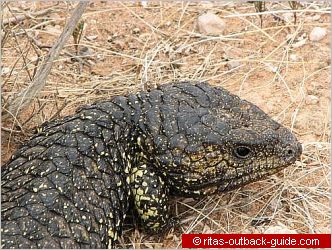
The easiest animals to spot are the various members of the lizard family. Especially the small stump-tailed lizards, or skinks, can be seen anywhere along or on the country roads. Drive carefully, and don't kill them!
Here you see stunning Australian wildlife photos taken out in the bush. You also learn some facts about the cute Australian creatures.
Capital Cities
Accommodation
Special Interests
- General Facts
- Australian States
- Photo Gallery
- Climate & Bushfires
- Australian Wildlife
- Australian Opal
Rent A Campervan
Koala Facts
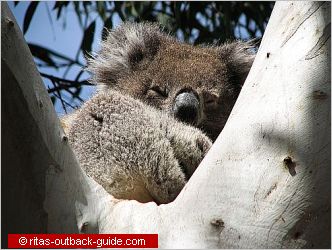
Australian koalas are NOT bears, although many people are talking about the "koala bear". Koalas are marsupials. It is said that the name koala comes from an aboriginal language meaning "no drink".
The koala below didn't like his photo taken, so he started climbing further up the tree.
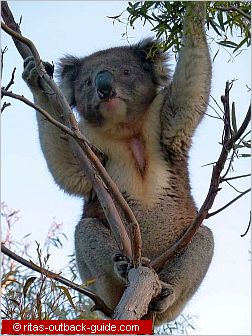
Koalas live in the woodlands in coastal regions of eastern and southern Australia. So they are not animals to be found in Outback Australia. Koalas feed on the leaves of particular Eucalyptus trees. Due to hunting in the early 20th century and destruction of their habitat they were nearly extinct.
Today koalas are protected, and it is not allowed to keep them as pets. That applies to most native Australian animals, by the way.
The average koala is about 70 - 80 cm tall, and weighs about 6 to 12 kg. Southern koalas are somewhat bigger and heavier than those in the north. And of course there is a difference between male and female animals. Koalas have a good sense of smell and highly developed hearing.
Koalas are well adapted to their life in trees. Their paws have long sharp claws for gripping and climbing. Koalas spend about 18 to 20 hours a day dozing in a tree. When they are awake they are mostly eating. Their digestive system is adapted to cope with the toxins in the gum leaves. Koalas rarely drink, but they can if they need.
The best places to spot a koala? That is hard to say. Most travel guides refer to the Grampians NP in Victoria, the Warrumbungle NP in New South Wales, and the Brisbane area. I nearly got a stiff neck while driving and walking in the Grampians, and I didn't see a single koala.
From my point of view, the Adelaide Hills are a great place to see koalas. Sometimes they even walk along the streets.
Wombat Facts
The wombat is another unique example of native Australian animals. The short-legged, muscular marsupial is a powerful digger. With an average length of one metre and weighing between 20 and 35 kg (44 to 77 pounds), the wombat is a sturdy animal.
There are three species of wombats: the common wombat, the southern hairy-nosed wombat and the northern hairy-nosed wombat
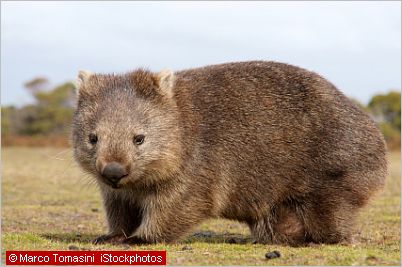
Wombats are nocturnal and spend most of the day in their extensive burrow systems. They can be found in south-eastern Australia, along the Nullarbour plain, and in Tasmania. Wombats are herbivores. They eat grasses, herbs, and roots. Their enemies are Dingos and the Tasmanian Devils.
Kangaroo Facts
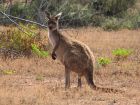
Kangaroos, wallabies, wallaroos, and pademelons are marsupials of the super-family Macropodoidea which means "large-footed". They are endemic to Australia. Smaller members of the family like wallabies and tree-kangaroos can be found in Australia and Papua New Guinea.
The kangaroo is an Australian icon. Along with the Emu it is featured on Australia's coat of arms to represend progress, as these animals only move forwards, never backwards.
There are more than 60 species of kangaroos, wallabies and wallaroos, pademelons and Quokkas. All kangaroos have powerful back legs with long feet, and a tail. The tail is sometimes called the fifth limb. It is used to balance while kangaroos are hopping. And boy, they can hop at fast speed. While the average speed is 20 -25 km/h, they can reach up to 70 km/h for a short distance.
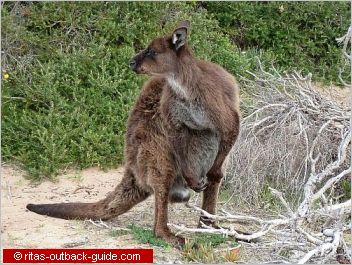
The red kangaroo is the largest marsupial, growing up to 2.7 m, while the Eastern Grey is the heaviest marsupial on Earth. Wallabies are usually smaller and don't weigh over 25 kilo. Otherwise, there's no real difference between kangaroos and wallabies for an ordinary person like me. I know scientists will disagree.
Kangaroos are grazers, eating a variety of grasses, and even shrubs. They spend the days resting in the shade. During the cooler evenings and nights they move around and feed.
The large kangaroos rarely have natural predators. Their numbers have increased since European settlement, while the smaller species suffered a lot from introduced animals like foxes, cats and rabbits. Some of the small kangaroo species are in danger of extinction.
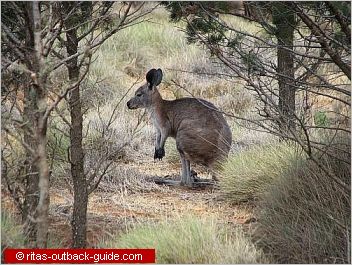
Like most native Australian animals, kangaroos are shy and usually no threat to humans. Male kangaroos box with each other to play, or to dominate. They also kick with their strong legs, and this could be dangerous to humans. So don't take any risks.
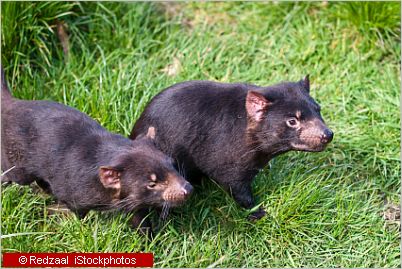
The Tasmanian Devil
The Tasmanian Devil is a carnivorous marsupial that lives in Tasmania. After the extinction of the Tasmanian tiger, the devil is the largest carnivorous marsupial in the world.
The stocky devil has the size of a small dog. It has black fur, white patches on its chest, long whiskers on its face, and a tail that is half the size of its body length.
Tasmanian devils have a loud screech that really sounds scary. They hunt, but also eat carrion. Devils usually live solitary, but sometimes they eat with other devils. However, this can turn out to be a loud affair with lots of fighting.