Bushfires in Australia
The Australian climate and the bushfire seasons
Bushfires in Australia are very common, they don't always end in a
catastrophe like the one in Victoria on Black Saturday 2009, Ash
Wednesday 1983 in South Australia, or the current fire crisis of the 2019-2020 season. The dry and hot Australian climate
during summers, accompanied by hot winds, nurture wildfires that get out
of control sometimes.
Therefore it is important and life-saving, for residents and travellers
alike, to be prepared for bushfires, obey all warnings and be careful and responsible, not only on days of extreme fire danger.
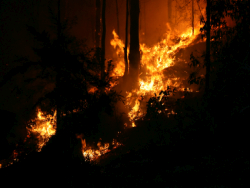
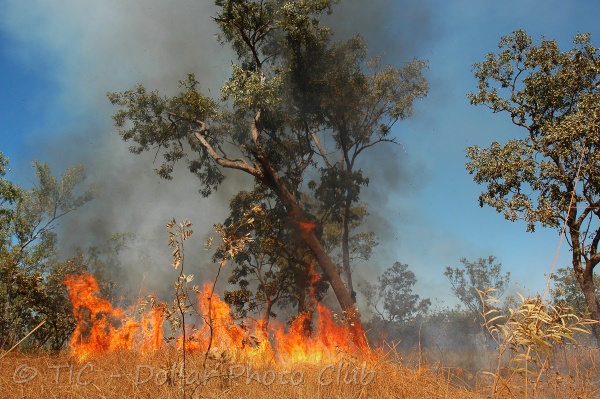 A grassfire in Australia
What to read on this page - Table of Content (TOC)
This page describes general facts about wildfires in Australia. However, I also include some information from recent major fire events.
2019 - 2020 fires in eastern and southern Australia -
random thoughts on a continuing nightmare
The fire season arrived early in the 2019. From September there have been serious fire events, first in south-eastern Queensland and northern New South Wales.
As temperatures rose and spring arrived in the southern states, there were more and more fires starting first in NSW, and in December in Victoria and South Australia.
Right now (November 2019), there are catastrophic weather conditions and out of control fires burning in places along the east coast.
Three people lost their lives, and about 200 homes were lost. And the worst is not over now.
Bush fires update January 2020
The fires along the east coast in NSW and Victoria have turned into a nightmare. There are fires out of control in the Blue Mountains and the Australian Alpine region. The damage is growing daily, and unfortunately, more lives and homes were lost now.
The Gospers Mountain fire that started in November grew to the biggest mountain fire in Australian history, burning more than a million acres in the Hawkesbury, Lithgow and Blue Mountain regions. The fire has been declared as contained on 12. January 2020.
Sydney and other towns have been suffering from dangerous air pollution for weeks. Nevertheless, the famous Sydney Harbour fireworks event on New Year's Eve was allowed, despite protests.
Record temperatures across the country have led to more fires in Victoria and South Australia. By the end of December coastal towns and resorts in southern NSW were threatened by the fires. People fled to the beaches. Major highways were partly closed. Despite the school holidays, people were asked not to travel into the regions where they could face fire danger.
In East Gippsland fires have been burning for weeks. By the end of the year, Mallacoota was hit hard. Tourists and locals where rescued from the beaches three days later.
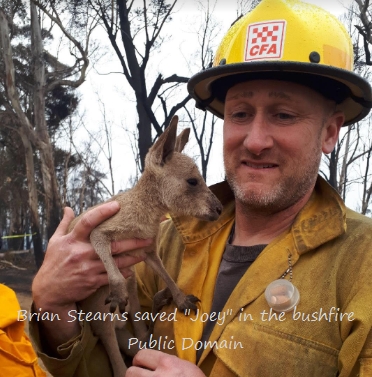 A firefighter with a rescued joey
I could really cry when I see reports in TV and newspapers.
The loss to nature and wildlife is disastrous.
Picture left: Brian Stearns, a Huron-Manistee National Forests employee is pictured with a kangaroo joey who approached firefighters in the field seeking refuge from the AustralianWildFires. We are continuing to mobilize U.S. Forest Service fire crews to assist during the AustralianBushfiresDisaster.
(Picture from Wikimedia commons public domain)
The Cudlee Creek fire in the Mount Lofty Ranges, South Australia started a few days before Christmas. 72 homes, animals, vineyards were lost.
On Kangaroo Island, the Ravine bushfire burnt about a third of the island. The loss of wildlife is immense, especially in the koala population. Those animals who survived the fires, have hardly anything to eat left.
The koala population on the island is unique because it is free of Chlamydia, an infection that causes infertility, blindness and death of the wild koalas on the mainland Australia. That's why the rescued koalas must be treated and fed on the island.
Donate for Kangaroo Island wildlife
The Kangaroo Island Wildlife Park is the place where injured and homeless wildlife is treated and fed. Click here to read more and make a donation.
Hanson Bay Wildlife Sanctuary with its unique koala walk was badly devastated by the fires. Click here to read more and make a donation.
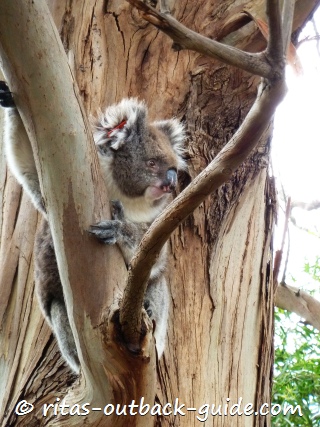 Koala at the Hanson Bay Wildlife Sanctuary
This photo was taken in spring 2010 during my visit at Kangaroo Island
To help people in the destroyed towns and regions everywhere throughout Australia, you can make donations to the Red Cross, St Vincent de Paul Society, the Lions Club, your local rural fire brigade and the Salvation Army. They all take donations to help those in need.
Planning a holiday? Travelling to the bushfire affected communities and spend your money there is a great way to help them getting back to normal life.
Update February 2020
The first week in February brought torrential rain across most of south-west Australia, so most of the blazes were reported as contained, or even extinguished.
So far, the 2019-2020 fire season has cost 34 lives, millions of
animals, both domestic and wildlife, died. The burnt grounds are
estimated more than 18 hectares, and destroyed nearly 6000 buildings, more than 2700 homes were lost.
Fatalities include the crew of three American fire-fighters who crashed with their air tanker near Cooma in NSW.
Wherever you are, stay safe, listen to your local radio station, have your fire plan ready, and leave the area as soon as the fire threat increases. Leaving early could save your life!
Last updated: 17. February 2020
The bushfire seasons in Australia
The different fire seasons reflect the varied weather patterns throughout Australia.
Australia's hot and dry climate contributes to severe fire events. The
danger for wildfires increases with low humidity, strong winds and high
temperatures.
Winter and spring (June to December) is the bushfire season in the tropical north. This is the "dry" season, and even in winter it can be very hot during the days.
The Australian centre has its fire season in spring and summer (September to March).
Finally, the fire season along the south & east coasts and Tasmania is from summer to autumn (December to April).
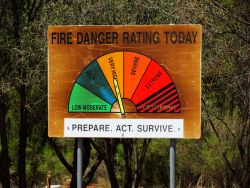
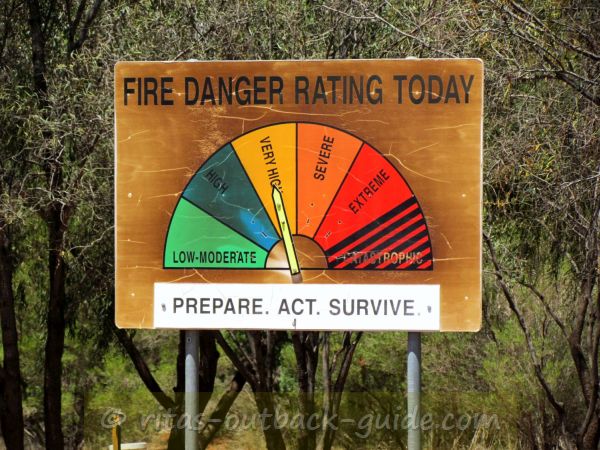 Fire Rating Sign
You will see all kinds of warning signs, giving you information about the fire danger on any given day. Whether they look like self-painted boards, or are high-tech signs, always take the message serious.
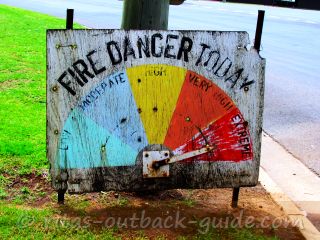 Old wooden warning sign
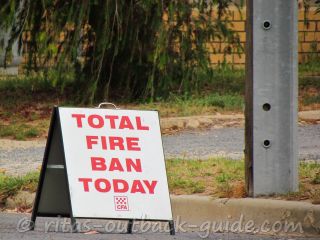 Total Fire Ban Day
Bushfires in Australia and the environment
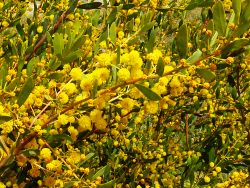
Bushfires have shaped the Australian environment, with many fire-adapted plant species that manage to survive a blaze.
Actually, bushfires often have benefit to plants and scrubs. Many
native species in Australia need the heat of a fire to make their seeds germinate.
Types of bushfires
Aborigines used controlled fires for land management, to burn dry grasses and scrubs, and support fresh growth.
It has been a subject of discussion for many years, whether or not
controlled fires should clear undergrowths in the woods to prevent
serious bushfire blasts.
Grass fires are moving fast with medium heat. They can be up to
three times faster than other bushfires. After years of flooding,
grasses grow very high, and cover huge areas in Australia. Good for
cattle and sheep. However, when the grasses dry out in the hot summers,
the risk of severe grass fires is very high.
Bushfires usually move slower, but have a high intensity
and smoulder for days. If the top of eucalyptus trees catch fire, the
fire can move much faster, yet, it might really explode!
Unfortunately, especially around the fringe of the cities, wildfires out of control end up in a disaster every couple of years.
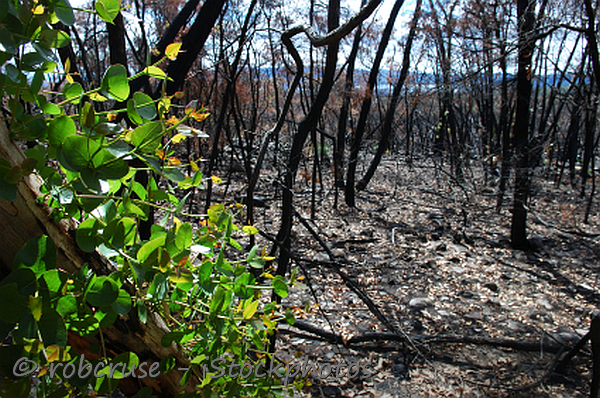 New growth after the bushfire
What happens to wildlife during bushfires in Australia?
Usually, the bigger animals like kangaroos, koalas, goannas and lizards
escape into the opposite direction when they smell smoke.
However, if a bushfire blasts, and the fire comes from several directions, it is hard to escape for animals and men.
A major bushfire destroys much of the flora, so animals have to
move from their territories to other areas in order to find food.
The severe bushfires in Victoria (2009) have certainly killed a lot of
wildlife. Many animals escaped with injuries and were taken to wildlife
shelters.
The story of a koala that was found by a fire fighter and rescued
went around the world. The fire fighters named the koala Sam. He drank
three bottles of water, so parched was he. Unfortunately, Sam died from
an infection a couple of months later.
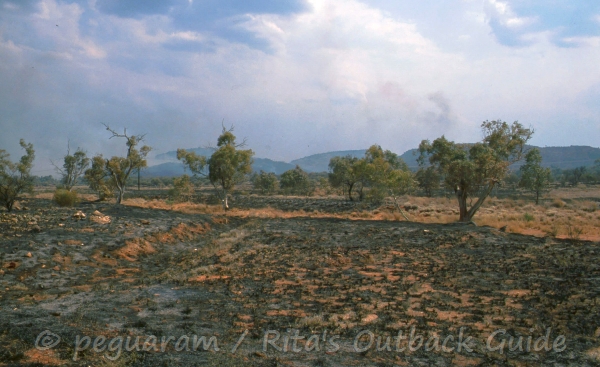 The ranges around Alice Springs on a day with several fires
What causes bushfires in Australia?
Low humidity, strong winds and high temperatures parch the land and the flora.
Lightning, careless people, and arsonists are the main factors that trigger bushfires in Australia.
Many Australian native plants, especially eucalyptus trees and
bushes contain oils that make the plants burn easily in dry conditions.
In a fire they really "explode"!
Most Australian states have a fire restriction season
during the hot summer months, usually from November 1st until the end of
March. Open fires are only allowed under certain conditions during this
time.
On days of total fire ban any fires outside are prohibited.
You can get more information about the fire restrictions and
total fire bans from local newspapers, radio and the fire authorities.
You'll also see the fire danger signs along highways and in Outback towns.
How to survive?
It is scary to think about this, and it is also hard to believe, but
you can survive a fast-moving fire in your car, or a house, provided you
are well-prepared.
The South Australian Country Fire Service has published useful information on their website. They explain things you should know in detail, and much better than I ever could.
Prepare, Act, Survive is the slogan to survive bushfires in Australia.
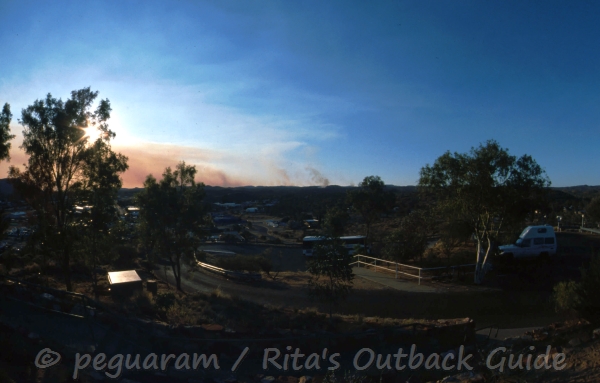 Bushfires on the horizon in Alice Springs
Bushfires in urban regions
It is a tragedy when huge areas of bush burn down in a fire, and wildlife gets killed. However, it is even worse when the fires reach settlements and the cities, and humans suffer, losing their houses and even their lives.
This can happen around all major cities in Australia. It is essential to seek information from your local fire services, and have a emergency plan in case a bushfire strikes in your area.
The beautiful Adelaide Hills are prone to bushfires, thankfully, it doesn't end as disastrous as the "Ash Wednesday" fires in 1983.
The new year (2015) started with a major threat for people living in the Adelaide Hills.
High temperatures & hot winds increased the fire danger. An
out-of-control fire burnt in the Mount Lofty Ranges.
Homes and lives were threatened in the Sampson Flat area.
I can tell you, driving down the free-way into Adelaide to spend
Christmas with your family in the Hills, and the indicator
boards don't mention traffic jams but only warnings about the high fire
danger, makes you feel a bit worried.
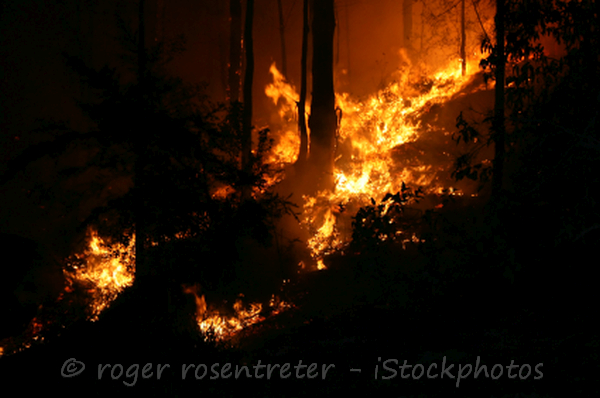
Black Saturday - A protocol of the Victorian blazes in February 2009
The fire disaster in Victoria is the worst bushfire catastrophe in Australian history.
The
bushfires death toll has reached 181 as of February 11, 2009. It is a
tragedy that shocks Australians and people around the world.
The fires have destroyed more than 750 houses and left thousands
homeless. And there are still fires burning in Victoria that are not
under control. Authorities fear that the number of victims will increase
during the next days.
Those who lost their homes and all belongings need our help!
The Victorian Premier has launched a Bushfire Fund in partnership with the Australian Government and the Australian Red Cross.
Donations from all around the world can be made by credit card
through the Australian Red Cross secure online donation page (not
available any more).
Please consider a small donation. Every dollar counts. Thank you.
The Australian Red Cross confirms that all donations go into the fund. There will be no money deducted to cover their costs.
Update March 1, 2009 - The Victorian bushfires death toll
has raised to 210, 37 people are still being missed. More than 2000
houses were completely lost, many more are badly damaged.
Four major fires are still burning, while 3000 fire fighters trying to keep them within control lines.
Strong winds are expected for Monday and Tuesday. A total fire ban has been declared for March 2nd.
I added this information box and protocol while the bushfires were
still burning. Thankfully, the number of people who died have been
revised down to 173 by the Victorian police on 30 March 2009. 414 people
were injured. Most people died in the Kinkglake/Whittelsea area.
February 7th 2009 has been referred to as Black Saturday ever since.
It will take a long time, but Australians are determined to build up their towns and houses.
Check out more Australian Facts and Stories

- Home ›
- Australian Climate ›
- Bushfires
Travel Advice during Sars-CoV-2 Outbreak

Do you plan to travel to, or within Australia? Restrictions apply due to the Covid-19 pandemic.
Please click here for the latest travel advice from the Australian Government.
Don't miss these popular articles

Connect And Follow Our Tracks
Please join me at Facebook & Twitter


Legal Stuff
ALL RIGHTS RESERVED