Outback Driving Tips & Facts
Stay safe on your travel adventure in Australia
Outback driving is not riskier than driving on any crowded highway at home. Likewise, driving on unsealed tracks in the Australian Outback needs the driver's full attention.
Forget the traffic jams. Enjoy the freedom to drive on empty roads in the beautiful Australian Outback!
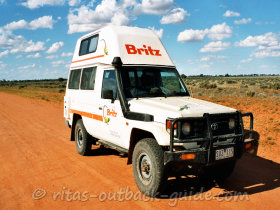
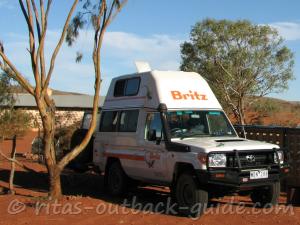
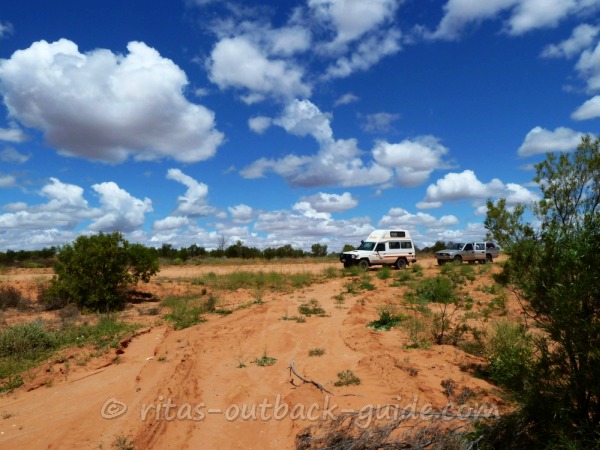 Campervan at the Silver City Hwy, Outback NSW
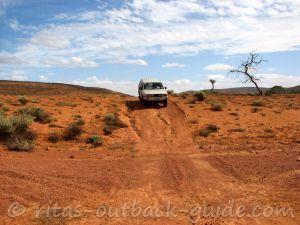
Conditions on dirt roads vary, depending on the weather, usage of the
road, and how long ago the grader went through. Usually, the main
Outback roads, although unsealed, are in fairly good condition.
Table of Content (TOC)
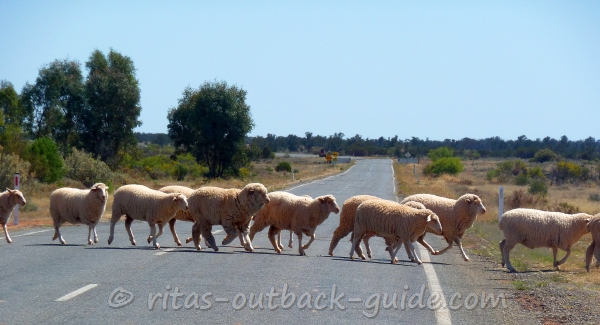 Sheep crossing the Silver City Highway - always expect animals on the road
At first, some basic rules for driving in Australia
To start with, driving in Australia is not hard, even if they drive on
the "wrong" side of the road. That's when you come from central Europe, or North America. Okay, there are still a few more
countries in the world who drive on the left, so the wrong or right
really depends on where you come from.
- A valid driver's license is required, of course. International visitors should have an international driving license, especially, if your license is not issued in the English language. But also bring your national drivers license.
- Speed limits apply in all states of Australia, but they vary from state to state, and even change within the state from time to time. If you're going to hire a car, you'll get the latest information. You can also check with the Australian motoring clubs.
- Always fasten your seat-belt, also when you sit in the back of the car.
- Drinking and driving is best to be avoided. A blood alcohol concentration limit of 0,05% is valid in all states. And they test you!! Even in a small bush town on a Sunday morning.
- Watch out for animals on the road. Apart from the native wildlife lingering on the road, there is also the risk that a mob of cattle, or a flock of sheep is driven over the road.
- I mentioned it before, Australians drive on the left side of
the road, but this is not a problem. After two days it is like you have
always done that.
Traffic in the cities will help you to do the right thing. On a lonely country road it is different, be aware to stay on the left side of the road then.
Emergency calls
If you have an accident with people being seriously injured call
the police and an ambulance. The emergency call is 000 from fixed
phones, and 112 from mobile phones.
106 can only be used with a teletype writer, this is the number for
anyone who have a hearing or speech impairment.
You can also use the triple zero emergency app to call 000. This gives the
emergency services your position using the GPS of your smart phone.
When you travel into very remote areas, consider taking a sat-phone or HF radio with you, just in case if you have trouble with your car, or health problems.
Even on main highways phone connection is not always given outside Outback towns. However, on main roads you won't have to wait long until another car arrives.
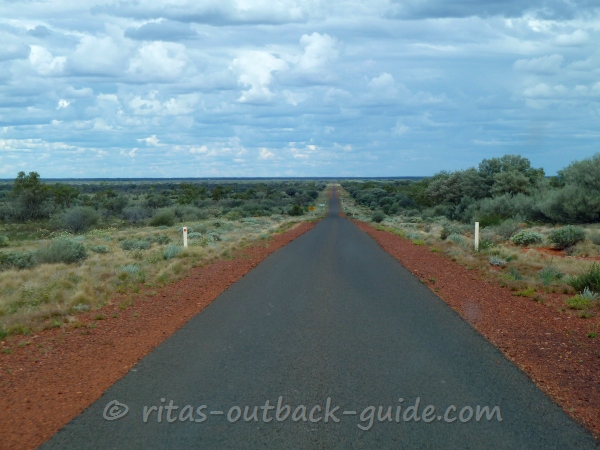 Narrow road in Queensland - get off the road when a truck approaches
Driving in the Outback
Sealed highways and roads
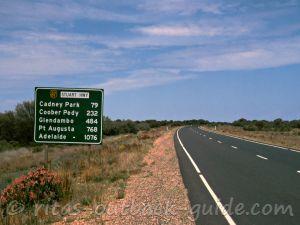
Many Outback roads are bitumen roads, marked as "sealed" road on a map. Actually, there are quite a few major highways that criss-cross the country, and can be used by any family car.
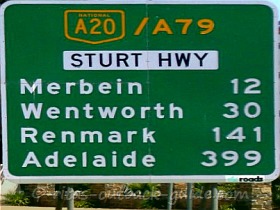
The Stuart Highway from Port Augusta to Darwin is the main connection from south to north in the centre of Australia. Yes. you reach Uluru and Alice Springs using that highway.
Eyre Highway takes you from Port Augusta to Perth across the famous Nullabor plain.
Another major route is the Barrier Highway which connects the central west in NSW with the vineyards of South Australia, and Adelaide.
Minor roads are often very narrow (one-lane road). When you see an oncoming car, slow down and move to the left so that your left driving wheels are on the gravel.
However, if the oncoming car is a truck, you better slow down and leave
the road completely. Don't force the truck to leave the bitumen. It
would only throw stones and dust on you anyway.
Don't forget, what you think is a truck could as well be a road train.
These "monster" vehicles can be up to 50m long. Bear this always in
mind when you try to overtake a truck/road train.
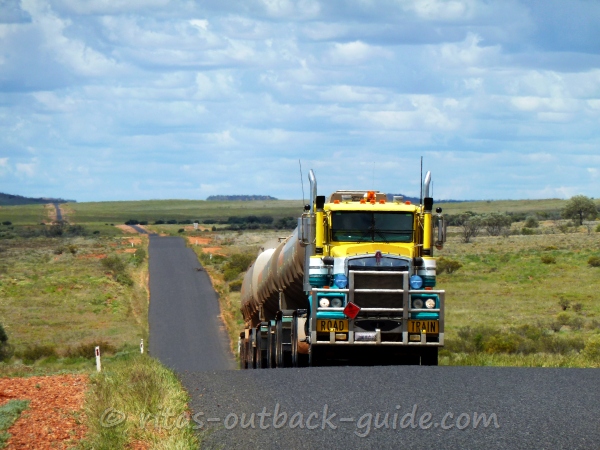 Road train on a narrow road in western Queensland
Another danger of Outback driving is fatigue, especially when you drive long distances on sealed roads.
From my experience, falling asleep won't happen as easily on a dirt road, because the rough surface calls for your attention. Nevertheless, plan frequent stops; there is always something worth to take a photo of.
Stop, revive and survive!
Unsealed roads and tracks - more tips for Outback driving
Now in Australia's inland you can expect a wide variety of road surfaces. From good gravel roads to extremely rough, rocky or sand tracks, everything can happen. When you go into remote areas and onto the famous tracks, investigate what conditions are like before you leave home. Below is a list where you get that information from.
You've heard about corrugated roads? It seems Australia is famous for them.
Pictured below is one of the worse roads in a national park in
New South Wales. Don't worry, it is not always that bad.
Find the speed
that makes the ride on a bumpy track comfortable for you. On roads like
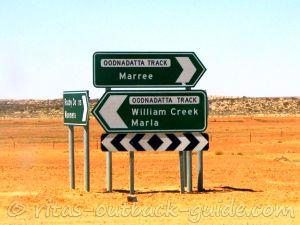
the Oodnadatta & Birdsville Tracks this could be a speed of 60 to 80
km/h (40 - 50 mph) if the conditions are good.
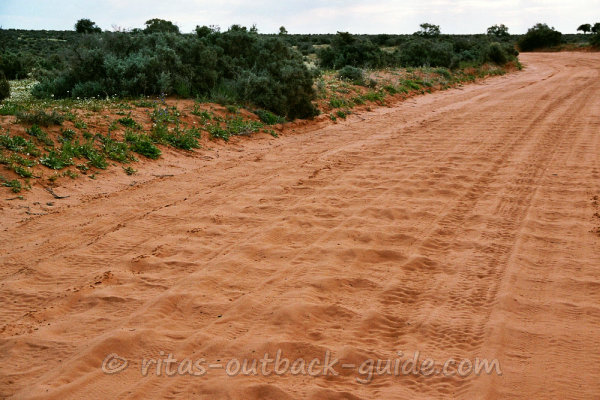 Corrugated road - Kinchega National Park, NSW
When driving on unsealed Outback Roads...
- Always be aware of hidden dangers like potholes and soft edges. If you are speeding you can turn your car upside down
- Drive with your headlight on. Other cars see you better in the dust cloud that surrounds your car
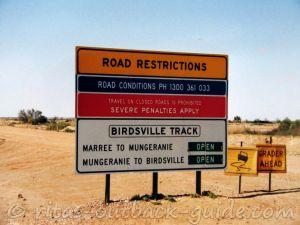
- Avoid driving on wet roads. The mud covers your tyres and you
easily lose traction. If a dirt road is closed due to rain, wait until
it dries out. The fines for driving on closed roads will ruin your
budget.
Never drive across a flooded river however shallow it seems. The current could sweep your car away. (Thanks Jill from "Art in Tropical Australia" for the tip). - When a road train comes across your way on a dirt road, it is a good idea to
drive as far to the left as possible. Slow down. Better still, stop and wait
until the truck has passed. You won't see anything driving in the dust of a road train.
If you have CB radio (Channel 40) and see an oncoming truck, you can call and let the driver know that you are around. Remember, it will take a long time for a heavy vehicle to stop, so just be careful.
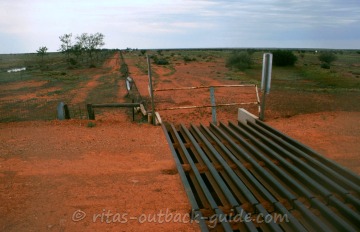 Grid on the Oodnadatta Track
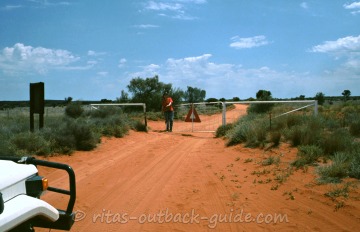 Leave the gate as you found it!
Grids and gates
- they help station owners to keep the animals in
the paddocks they should stay in. On main roads there are grids,
animals won't walk over them. There's hardly ever a problem with grids
on bitumen roads. However, be careful on unsealed roads, slow down.
Because of washouts it can be a bumpy ride over the grid.
Minor roads and station tracks just have a gate. You, or the co-driver, have to get off the car and open
the gate, if it's closed. Don't forget to close it after you have
passed. The golden rule is: Always leave a gate as you find it!
When you have driven on rough tracks all days, the gate stop is useful to have a look at the car to check if everything is still in place.
That reminds me on another fact you should realise while driving throughout
the Australian Outback. Almost always you traverse private property. Please stay on designated roads and tracks.
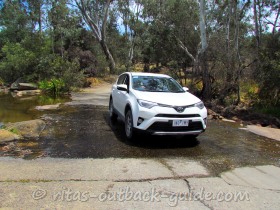
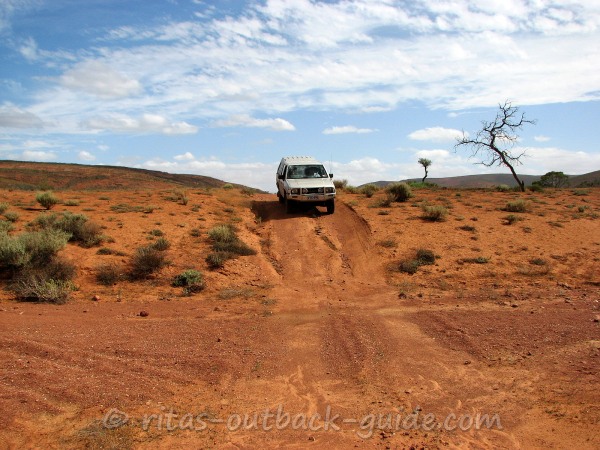 Crossing a dry creek bed in the Gawler Ranges
Where to check road conditions
Desert Parks Bulletin South Australia (PDF) - Hotline: 1800 816 078
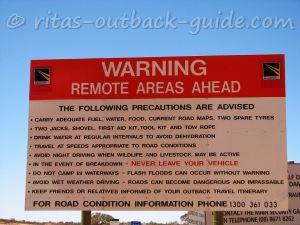
Outback Roads South Australia - Ph: 1300 361 033
Live Traffic New South Wales - RTA Ph: 132701 or ring the NRMA 131122, NSW western regions 80826660
RACQ Queensland - Ph: 131905 Live Traffic Queensland
Northern Territory Road Reports - Recorded information Ph: 1800 246 199
VIC Roads - Road closures & Traffic alerts
The Bureau of Meteorology has always the latest weather warnings on the homepage.
Useful Tips for your Australian Outback adventure
Questions & Tips
Googs Track 2
I Have travelled Gawler Ranges, Googs track, Tarcoola, Kingoonya, Mt. Ives and Lake Gairdner last September.
The only problem we encountered was on Googs …
Planning to drive from Melbourne to Uluru
Dear Rita,
my husband and I are planning to go on a holiday driving from Melbourne to Uluru with our camping stuff in 13 days.
I know it is gonna …
Brisbane to Alice Springs
Can I drive from Brisbane to Alice Springs and back (circuit via Mt Isa) on tarseal 2WD 6 Berth Camper ?
Hi, I want to travel from Brisbane to Townsville, …
Googs Track through to Mt Ive
We're planning to do Googs Track (SA) and through to Mt Ives and Lake Gairdner, etc in October 2011.
Can anyone update us on current track conditions …
Big trip from Brisbane-Adelaide-Alice-Rocky to Brissy
Hi, we are doing a family trip over Christmas to Adelaide. We want wanted to takes some sights in along the way, I have done a rough idea on the map of …
Adelaide to Ayers Rock
Hallo,
we are planning a trip from Adelaide leaving the 6th August to Ayers Rock. We have our flight leaving the 10th August.
We would like to rent …
Visiting Australia for 12 months
Motorhome or 4wd & tent camper set up?
Hi Rita,
we are a family of 4 (kids 5&3) and are looking to travel around Australia for 12+ months. We …
4x4 Hi or Low drive on Tracks?
Hi Rita
Thank's for a great site :o)
I'm planning a trip along the Oodnadatta Track, Birdsville Track, and to Halligan Bay in February 2012 in a Toyota …
Brisbane to Port Hedland
Planning on driving my Holden Rodeo 2wd ute from Brisbane to Port Hedland.
I'm travelling alone, I'm a 24yo female. I am extremely excited about this …
Free camping along Stuart Highway
We are planning a trip from Port Augusta to Darwin and I was wondering if you have any advice on free camping in this part of Australia. What are people …
Family holiday to Uluru from Melbourne
Hi - I am needing some help from you all out there who have travelled and are familiar with the Outback.
My family and I definitely aren't but we are …
Just how far off-road can one go with an AWD Ford Territory ?
I'm not ashamed to admit that I am a novice when it comes to tackling the Outback roads (between Port Augusta / Alice Springs and Uluru), but I am a …
First outback trip
Hello we are hiring a 4WD Cheapa campa from Apollo (The Bushcamper sold out) and are picking it up from Alice Springs on Tuesday!
We are looking to …
Campervan adventure east coast and the Outback!!
Hi, we are planning travelling up the east coast of Australia and through the Northern Territory in a campervan. We fly out of Darwin and so we have to …
Uluru to Brisbane - quickest way home?
Hi Rita, love this website!
We are doing a big trip from Brisbane to the Top End, the Kimberleys, Red Centre and back home to Brisbane. By the time we …

telephone coverage
My husband and I are planning a trip from Adelaide to Alice Springs via the Oodnadatta track and possibly on to Darwin.
We have mobile phones with …
Travelling from Windorah QLD to Birdsville
How good/bad are the Diamantina Development and the Birdsville Development Roads, (Windorah to Birdsville)? There are plenty of write-ups about the Birdsville …
Brisbane-Bourke-Broken Hill-Adelaide
What would be the right choice?
Hello,
I'm planning a trip, starting around Dec 27th for 12? days to travel from Brisbane to Bourke to Broken Hill …
Christmas in the Outback
From Alice Springs to Adelaide in 10 days, hoping to see MacDonnell Ranges, Kings Canyon, Uluru and Olgas, Cooper Pedy and Flinders Ranges.
Any suggestions? …
Yunta - Cameron Corner - Broken Hill
How far will our trip be and what will the best way be?
Hi, We are planning a caravanning trip with a few families starting from Balaklava SA to Yunta, …
Campervan in Outback
Hello!
We would like to travel from Melbourne to Adelaide, then through Alice Springs ( and turn to Ayers Rock) to Rockhampton or Townsville by campervan …
- Home ›
- Outback Driving
Travel Advice during Sars-CoV-2 Outbreak

Do you plan to travel to, or within Australia? Restrictions apply due to the Covid-19 pandemic.
Please click here for the latest travel advice from the Australian Government.
Don't miss these popular articles
Connect And Follow Our Tracks
Please join me at Facebook & Twitter


Legal Stuff
ALL RIGHTS RESERVED